A View of Planet Earth With Summer - Page 6
 |
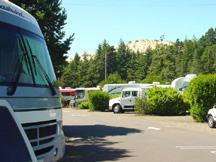 |
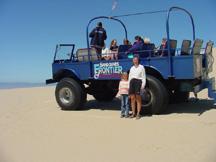
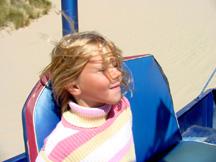
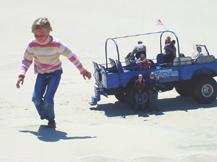
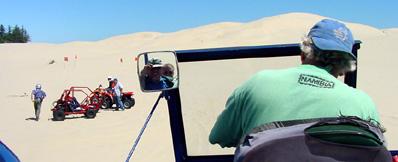
Now it was time for a change in scenery and so we decided to head for the ocean. We ended up just south of Florence, Oregon where we found an RV park (Woahink Lake RV Resort) that could accommodate us (even though it was vacation season and we did not have reservations). This is a very popular area for vacationers because it is near the ocean, and because it is a Mecca for those who like to play in the giant sand dunes with their all-terrain vehicles. We got a good sample of what it is like to whiz up and down those sand dunes when we decided to take a sand dune tour in a fifteen-passenger dune buggy. We thought it would be a nice comfortable slow ride around and between sand dunes, and it actually started out that way. However, after a short introduction through the area, we found the driver heading up a high ridge with the steep leeward slope right next to us. And then with a sharp right turn, we found ourselves looking straight down this long steep slope. It felt like a fast roller coaster ride with accompanying screams as we swooped down with sand flying in all directions. Summer loved it! What a new and exciting experience this was. Summer sometimes goes jeepin with her dad in mountainous rough terrain, but her dad never took her on something like this.
 |
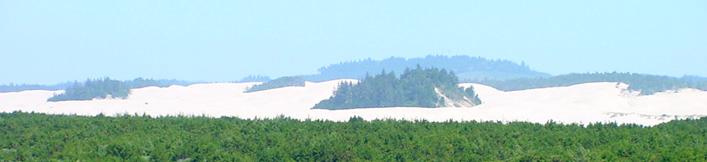 |
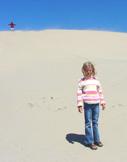
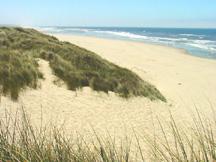
These dunes are part of the Oregon Dunes National Recreation Area and it contains some of the largest ocean front dunes in the world, ranging over 500 feet in height with sand banks over 2.5 miles long. They are the largest expanse of coastal sand dunes in North America and stretch over 40 miles between Florence and Coos Bay, Oregon. There are several theories about how all this came to be, and one goes like this: Over 12 million years ago, much of Oregon was under the ocean and there was a thick sandy sea floor. Part of this seafloor was then uplifted and the associated sandstones became part of the Pacific Mountain Coastal Range. Glaciers, heavy wind and rain have constantly eroded these hills and mountains and the eroded material is carried back out to the ocean by rivers. Storms, waves, and tides then bring it back to shore where the sun dries it and strong winds carry it inland as sand dunes. It is predicted that the dunes will be completely overgrown within 50 years by European beach grass, which was introduced years ago to control dunes along roadsides and river channels. This plant has been much more effective than anyone ever imagined, and now there are efforts being made to try and control the plant.
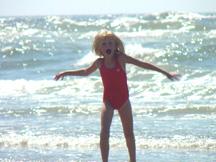
After riding the dunes, it was time to enjoy the ocean beach for a while. The sun was shining brightly and the sand on the beach was hot, but this was tempered with a cooling breeze coming off the ocean. It was very comfortable lying on a beach blanket and Summer had a good time frolicking in the ocean waves as they splashed ashore.
 |
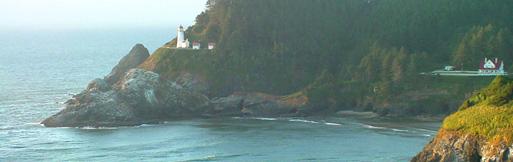 |
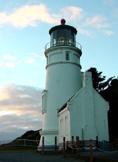
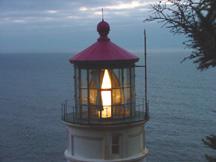
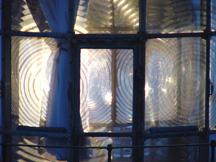
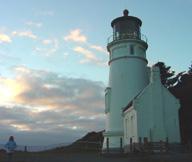
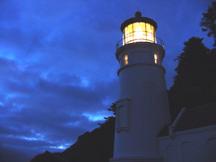
Our next and last adventure before heading back home took us to the Heceta Head Lighthouse. We had heard that there would be a special early evening tour of this place just north of Florence, Oregon and we thought it would be a fun thing to do. We arrived at the lighthouse about 7pm when it was still daylight and then watched the sun go down over the ocean as the lighthouse took charge in providing a navigation beacon for ships far out (21 miles) at sea. This lighthouse stands 150 feet above the ocean and is one of the most photographed on the coast. The light at the top of the 55-foot tower (205 feet above sea level) with its first-order Fresnel lens was illuminated in 1894, and the now automated beacon is rated as the strongest light on the Oregon coast. The lighthouse is named for Don Bruno Heceta of the Royal Spanish Navy who in 1775 sailed out from San Blas, Mexico with 45 men in a mission to head for the Arctic Circle and claim points enroute for Spain. On his journey, he noted this headland, which now bears his name.
 |